ESPboy
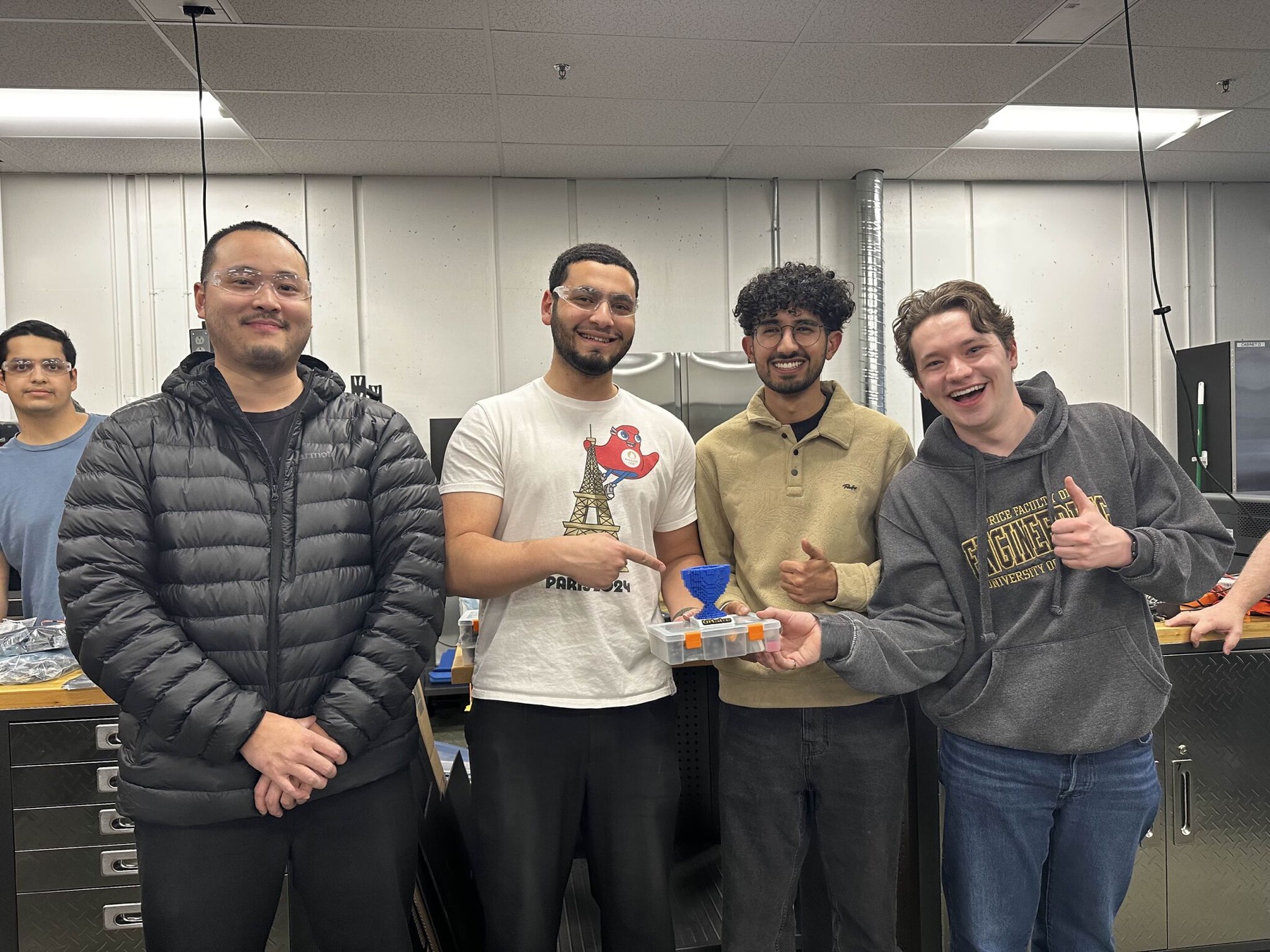
1st Place - Most Extraordinary Design and Implementation Award
Built in less than 24 hours at UMIEEE UMake 2026, ESPboy combined two ESP32 devices, a hand-soldered LED matrix display, embedded C/C++ games, ESP-NOW wireless control, and a Node.js-backed web experience for live spectator interaction.
Tools and Languages
1st Place
UMake 2026 result
<24 hr
Designed and built
2x ESP32
Wireless devices
2x 8x8
LED display
2
Playable games
Overview
ESPboy is an interactive ESP32-powered gaming platform built from scratch during the first UMake hardware hackathon. The system pairs a wireless controller with an ESP32 game console running retro games on two hand-soldered 8x8 LED matrices, then adds a live web layer that lets spectators vote to influence gameplay.
System architecture
- A dedicated ESP32 controller captures physical button input and sends low-latency packets to the game console using ESP-NOW.
- The ESP32 game console runs the game loop, collision detection, rendering, LED matrix updates, controller callbacks, and spectator-driven gameplay changes.
- Two hand-soldered 8x8 LED matrices create a constrained 16x8 display for compact versions of Tetris and Snake.
- A browser-based spectator interface connects through a Node.js gateway so audience votes can modify the embedded game state in real time.
Player vs. crowd interaction
The defining feature was the audience loop. Spectators could join from a phone or laptop, follow the game, vote, and trigger obstacles or disruptions that changed the live game state. That turned a small embedded console into a player-vs-crowd experience instead of a conventional single-player hardware demo.
Networking decision
The team used ESP-NOW for direct ESP32-to-ESP32 controller communication because it avoids a traditional Wi-Fi access point and keeps controller input lightweight. For the web audience, a Node.js reverse proxy/gateway reduced the load on the resource-constrained ESP32 by funneling many spectator connections into a controlled interface.
Hackathon constraint
- Designed, soldered, programmed, integrated, and demonstrated the project in less than 24 hours.
- Balanced embedded firmware, physical hardware, wireless networking, web software, and live demo reliability under a hard deadline.
- Scoped the idea around a clear product experience: a physical player battling a live audience.
Outcome
ESPboy won 1st Place - Most Extraordinary Design and Implementation Award at UMIEEE UMake 2026 because it combined technical breadth with an immediately understandable interactive demo.
Things learned
- A strong hackathon project needs a simple user story that makes the engineering visible without requiring a long explanation.
- Resource-constrained embedded displays force careful design decisions around game state, timing, and visual clarity.
- A small gateway layer can make a hardware demo much more scalable by separating web traffic from microcontroller responsibilities.